


Auto-Invest on Lendermarket
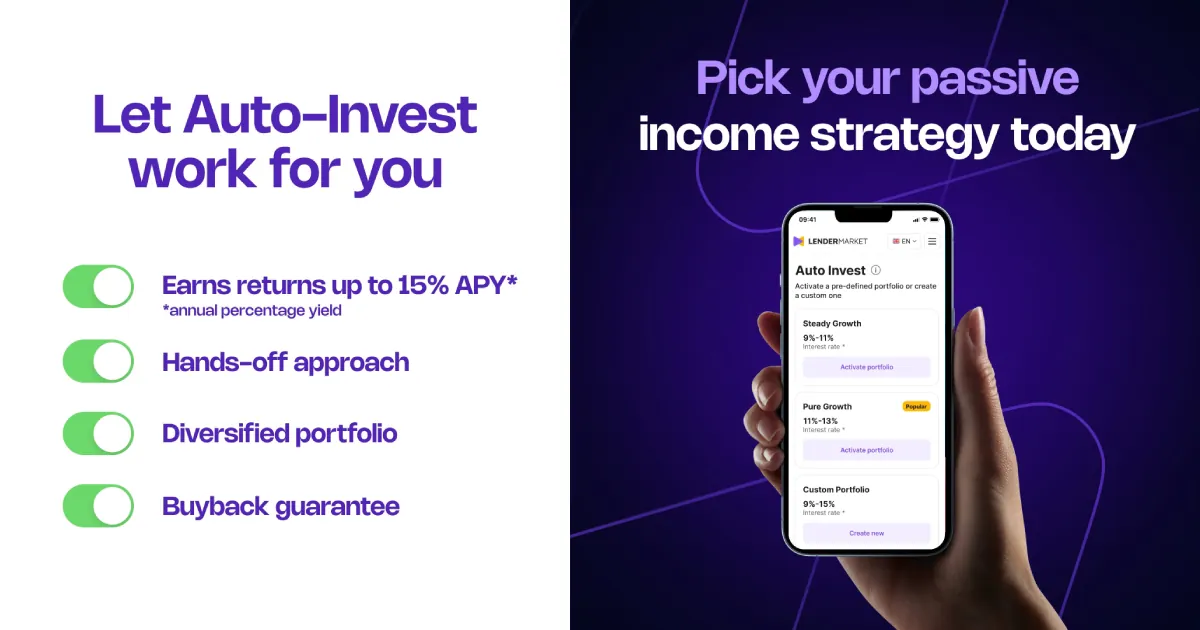
The Auto-invest feature offered by Lendermarket allows investors to automate their capital allocation through investment portfolios. Once these portfolios are activated, Auto-invest reviews the loans available on the platform, selects those matching the defined parameters and commits the funds held in their account.
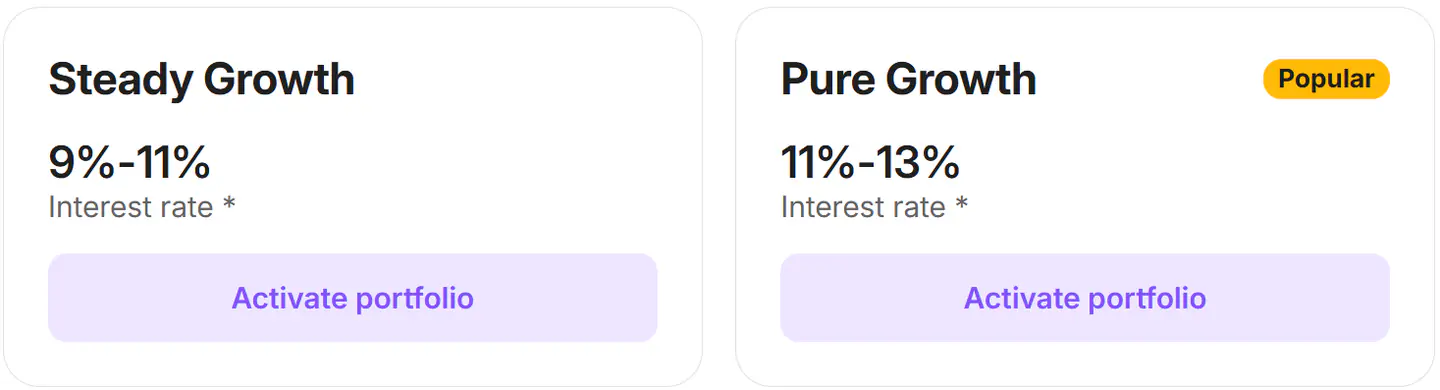
Two options are available : ready-made portfolios, Steady Growth and Pure Growth, which can be activated without any prior setup, or a custom portfolio. With this second option, investors define their own allocation criteria : loan originators, minimum interest rate, loan term and maximum amount per loan.
Allocation Mechanics
How Auto-invest works is specific to each P2P lending platform, which decides on its own selection and allocation rules. On Lendermarket, these rules apply the same way to all portfolios, whether ready-made or custom. Several principles govern how funds are committed.
Loan review : as soon as a portfolio is activated, Auto-invest goes through the loans listed on the platform and commits funds to those matching the defined parameters. Any change to the parameters triggers a new review.
Priority order : when several portfolios are active, they are processed in an order that investors set by drag and drop. Each portfolio takes over when the previous one reaches its target size or no longer finds eligible loans.
Amount committed per loan : when available funds are not enough to reach the maximum amount configured, Auto-invest commits the entire balance, provided it reaches 10€. Below this threshold, no offer is made.
Eligible loans : Auto-invest only selects loans that are up to date with their payments. Late loans are excluded from automated selection and can only be acquired manually.
Offers are final : Auto-invest does not purchase the loan immediately. It submits an offer, which the loan originator can accept within a predefined period. Funds are reserved in the meantime and the offer cannot be canceled or changed.
Auto-Invest Benefits
Automation addresses a constraint specific to P2P lending. Since invested capital keeps coming back as repayments and interest, it has to be reinvested to continue generating returns. Auto-invest handles this and offers several benefits.
1. Automatic reinvestment : repayments and interest received are credited to the available balance, then reinvested without human intervention, which keeps capital deployed and limits cash drag.
2. Responsiveness : since Auto-invest runs several times a day, it can invest in new loans as soon as they are listed. Investors cannot monitor the platform continuously on their own.
3. Time savings : building a diversified portfolio requires selecting loans one by one, meaning a large number of transactions that Auto-invest handles automatically.
4. Diversification : the criteria allow investors to spread capital across several loan originators and to cap the amount invested in each loan, which reduces exposure to a single originator.
5. Multi-portfolio management : by creating and prioritizing several portfolios with distinct criteria, investors can favor one category of loans while keeping a fallback allocation.

Auto-Invest Limitations
Automation does not remove the constraints specific to the platform. Some limitations come from how Auto-invest itself works, others from the available loan supply. Investors should be aware of them before creating a portfolio.
1. Regulated or unregulated loans : a portfolio covers either regulated or unregulated loans. Covering both requires two separate portfolios.
2. Limited loan supply : depending on the criteria selected, the number of eligible loans can become very low, especially on the regulated side where there are few loan originators.
3. Minimum amount per loan not adjustable : only the maximum amount per loan can be set. Investors cannot define a minimum amount, which limits control over portfolio granularity.
4. Late loans excluded : Auto-invest only selects loans that are up to date. Late loans, sometimes carrying a higher interest rate, are only available through manual investing.
5. No secondary market : loans acquired through Auto-invest are held until maturity. There is no resale mechanism outside the Auto-invest FLEX product.

Setup and Settings
Ready-Made Portfolios
Lendermarket offers two preset portfolios, Steady Growth and Pure Growth, which differ only in the interest rate range they target. All their other parameters are identical : target size, loan term, minimum and maximum amounts per loan.
The “Activate portfolio” button allows immediate activation, while the “Show details” link lets investors adjust the parameters. The service type (regulated or not) still has to be defined, which activates the corresponding loan originators, a list investors can then modify.
One point worth noting : on the regulated side, a link to the Key Investment Information Sheet appears below the parameters. This document, required by Regulation (EU) 2020/1503, sets out the characteristics of the loan and the associated risks. It does not apply to unregulated loans.
Custom Portfolios
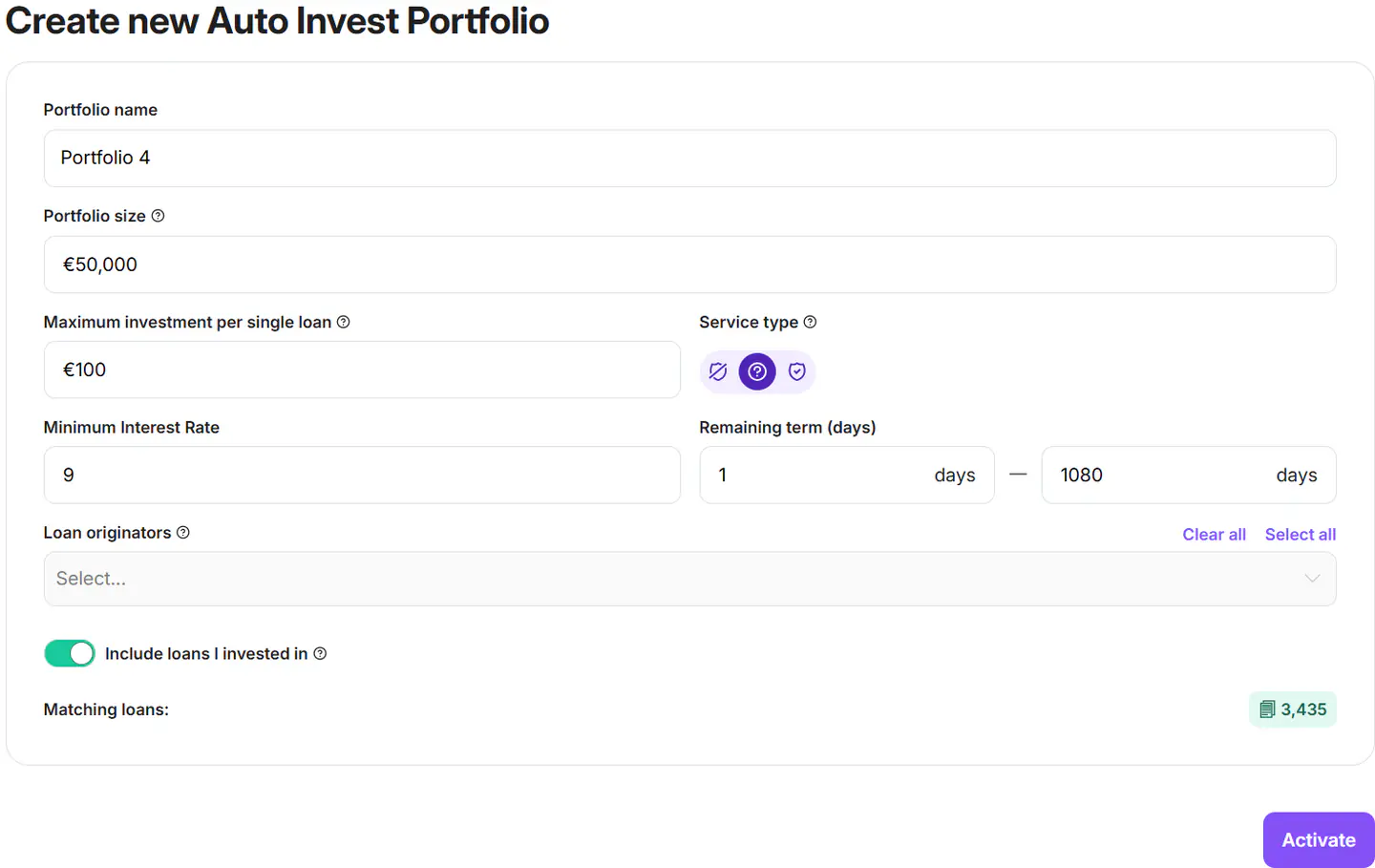
Creating a custom portfolio opens a form where investors define each criterion themselves. They choose a name for their portfolio, then decide on the total amount they want to allocate to it (Portfolio size), as well as the maximum amount to invest in each loan.
The service type must then be selected, since without it the portfolio cannot be activated. This choice determines the list of loan originators available, as each portfolio can only cover either regulated or unregulated loans, never both.
The remaining criteria are the minimum interest rate, a minimum and maximum remaining term in days, and an option to include loans investors already hold. A counter shows the number of matching loans in real time, which helps fine-tune the criteria before activating the portfolio.
Tracking and Managing Portfolios
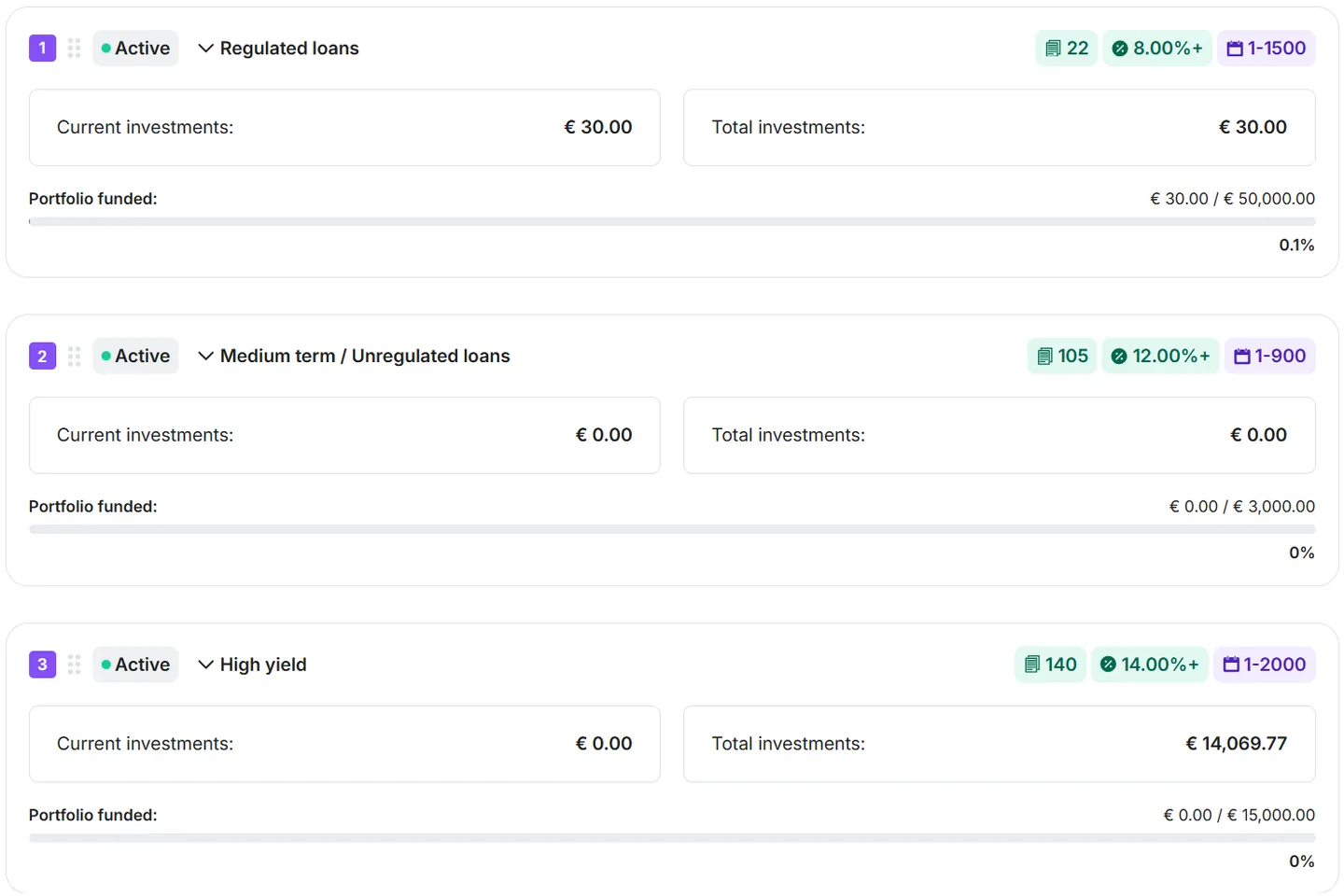
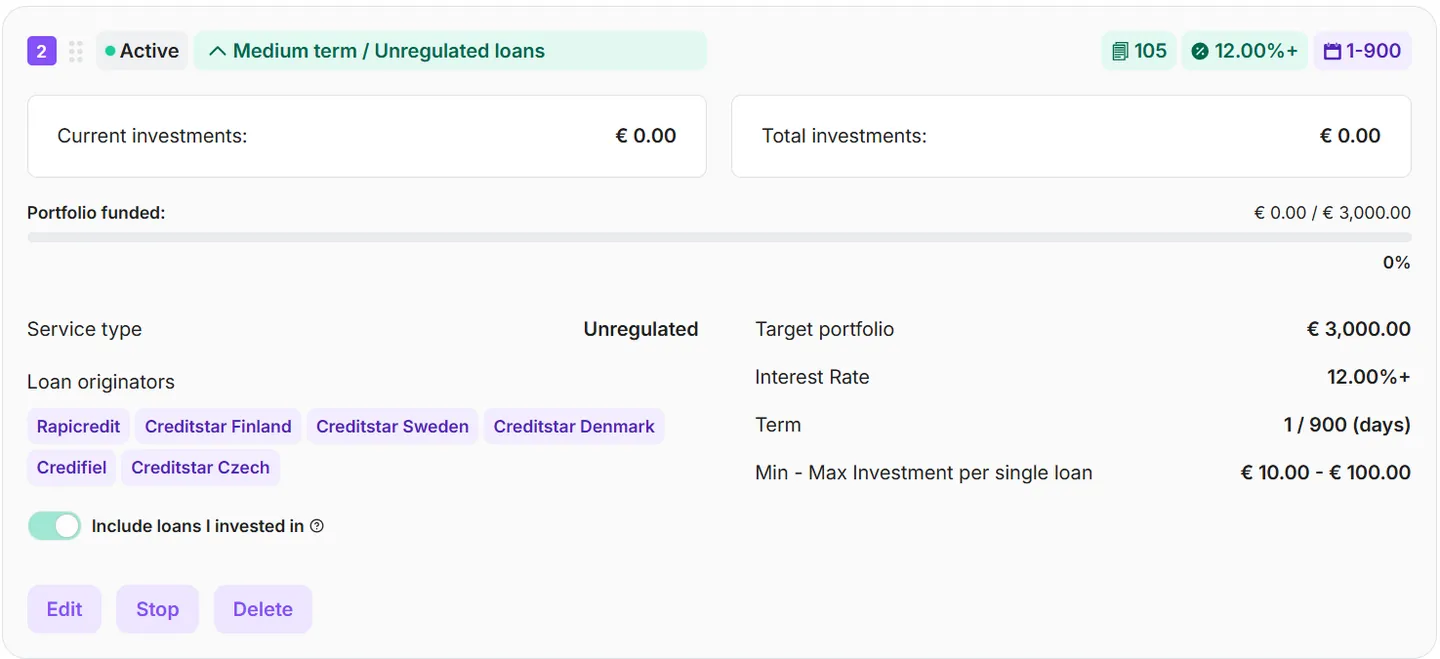
The Auto-invest portfolios screen brings together all portfolios created, whether active or stopped. Each one shows its status, priority rank, main parameters, the number of matching loans, as well as the amount currently committed and the total invested since creation.
Three actions are available on each portfolio : edit its parameters, stop it or delete it. A change only affects future investments, as positions already taken continue until maturity under their original terms.
Editing is typically necessary when a banner indicates that the parameters are no longer supported and that the portfolio has stopped investing. This applies to portfolios created before the form was redesigned, where some criteria were converted during the switch to the current version.
Optimization Tips
Calibrating the criteria determines how effective Auto-invest will be. Requirements that are too strict on interest rate or term sharply reduce the number of eligible loans, to the point of leaving funds uninvested. The counter displayed during setup helps measure the effect of each criterion.
Since a portfolio can only cover one category of loans, running two portfolios in parallel lets investors access both regulated and unregulated loans. Their priority order then determines which one is funded first.
Once the portfolio is activated, it is worth checking the first investments made. This confirms that the loans selected match their objectives, and lets investors adjust the criteria if the resulting allocation differs from what was intended. Changes remain possible at any time.
➡️ Subscribe to the Just-P2P Newsletter

Is Lendermarket Auto-Invest Worth It ?
The value of Auto-invest depends mainly on the amount invested. On a large portfolio, repayments and interest come in continuously and reinvesting them manually quickly becomes tedious. On a smaller portfolio, logging in regularly is more than enough to reinvest the amounts received.
In my experience, Auto-invest is mainly useful to target high-yield loans while limiting the investment term, as some loans on this platform run for several years. Careful setup beforehand is therefore essential to preserve a certain level of liquidity, and it also prevents configuration errors that are difficult to correct.