



The main shareholder
The largest shareholder is Karlheinz Hauptmann, holding 62.59% of the shares. He holds a Ph.D. in Economics from Freie Universität Berlin (1986) and began his career in investment banking. He worked in equity derivatives at Bankers Trust International and later as Managing Director at Merrill Lynch International in London.
In 1992, he founded Telor Capital Management a.s., a Prague-based private equity firm focused on Central and Eastern Europe, as well as farming and wine investments globally. He has served as Chairman of the company for over 30 years and was one of the platform’s first supporters.
Other significant shareholders include KJ Holdings OÜ (9.47%), owned by co-founder Kimmo Rytkönen, MR Holdings OÜ (5.21%), owned by co-founder Meliina Räty, and Tolaram Fintech Pte. Ltd. (2.78%). The remaining shares are distributed among angel investors, private equity firms, and smaller private investors.

Platform founders
Kimmo Rytkönen is the driving force behind Income Marketplace and served as the platform’s first CEO. He has been working in the international lending business since 2011 and co-founded Tunaiku, the lending arm of Indonesia’s Amar Bank, a joint venture with the Tolaram Group. He holds 9.47% of the shares through his company KJ Holdings OÜ.
Kimmo also founded Aasa Polska, a Polish lender that was represented on Mintos at the time, and was involved with Aasa Global and Supernova JV. As a private P2P investor during the COVID-19 crisis, he saw how poorly investors were protected, which motivated him to create Income Marketplace.
Alongside Kimmo, two other co-founders established the company in July 2020. Mikk Läänemets is a lawyer by profession who previously worked at the Aasa lending group. Meliina Räty served as the platform’s first Chief Operating Officer until the end of 2021.


Income Marketplace statistics | December 2025
Here are some statistics for the current year:
- Total funds invested : 201.5 M€
- Total interests paid to investors : ~6.1 M€
- Average annual return : 12.08%
- Number of investors : +10,200
As of late 2025, Income Marketplace has facilitated over 201.5 M€ in loan investments since its inception in 2021, with approximately 6.1 M€ already repaid to investors. The platform serves now more than 10,500 investors and records an average monthly investment volume of 5.7 M€ over the last 12 months.
In 2025, this P2P platform delivered an average annual return of approximately 12% p.a. to registered investors, with monthly figures ranging from 11.30% to 13.4%. Regarding investor acquisition, the marketplace attracted an average of 125 new investors per month throughout the year.

How does Income Marketplace work ?
Income Marketplace is a peer-to-peer investment platform connecting investors with loan originators from European countries and Indonesia. The platform acts as an intermediary in the sale of claim rights between investors and lending companies, enabling investors to co-fund the loans they choose, earning interest payments in return.

Income Marketplace is a P2P marketplace
Income platform operates as a P2P lending marketplace, serving as an intermediary between investors seeking returns on their capital and loan originators offering loans for financing. Based on an Assignment Agreement, investors purchase claim rights arising from the underlying loans and receive interest according to the predefined terms.
Income controls and monitors the loan originators to ensure proper operations. The platform monetizes itself through a commission fee charged to lenders for financing their loans, ranging between 2% and 4% of the outstanding loan portfolio, calculated on a daily basis and invoiced monthly.
Income Marketplace collaborates with 11 active loan originators across multiple regions, offering investors geographical diversification. The platform works with lenders in Eastern Europe (Lithuania, Latvia, Estonia, Bulgaria), Western markets (Spain, UK, Kosovo), and Southeast Asia (Indonesia).

Due diligence and onboarding investment
Income’s onboarding process begins with initial data collection, requiring legal documentation, financial statements, and details on the loan origination process. The risk manager analyzes the documents, focusing on loan book performance and portfolio profitability.
If the lender lacks an established track record, Income may require a group guarantee. The platform then calculates the junior share, the portion of loans the lender must retain, and performs final compliance checks to confirm loans are properly backed by collateral.
If all criteria are met, the lender is onboarded and API integration allows Income to directly monitor listed loans. Every six months, the platform evaluates the entire loan portfolio to determine adjustments to the junior share and ensure ongoing compliance.

Main loan originators
DanaRupiah (Indonesia) : The Indonesian lender has been with Income since December 2021. It offers short-term and installment loans with a maximum term of 6 months and interest rates up to 13%.
Ibancar (Spain) : On Income since 2017, this Spanish lender has been on various P2P platforms including Iuvo Group. It offers installment loans with interest rates of 9.5-11.5% and terms of up to 38 months.
Sandfield Capital (UK) : The FCA-regulated lender offers financing for civil litigation, covered by external insurance. Interest rates up to 13.5% with terms of 15-24 months.
Virtus Lending (Kosovo) : Added in March 2025, Virtus Lending has offered used car leasing and consumer loans since 2019. Interest rates of 10-12% with terms ranging from 3 to 86 months.
ITF Group (Bulgaria) : Founded in 2012, on Income since July 2022. It offers short-term consumer and installment loans with interest rates of 11-12% and terms of 1-25 months.
Hoovi (Estonia) : On Income since May 2022, the Estonian lender offers installment loans at 7-10% interest rates with terms from 8 months to 10 years.

Chronology of a P2P investment
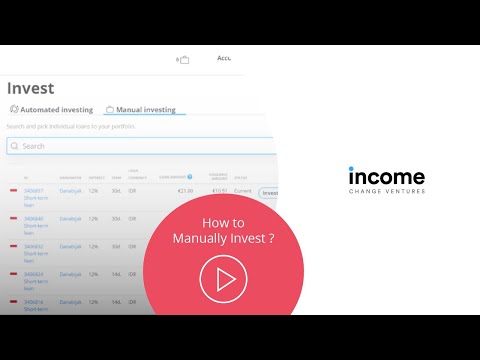
On Income Marketplace, the minimum investment is 10 € per loan. Once invested, funds are transferred to the loan originator. Interest is accrued daily, calculated as follows: Invested amount × Number of days × Interest rate / 365. Interest payments are transferred to investors on a monthly basis.
A loan can be overdue for up to 60 days past its scheduled payment date, during which investors continue to earn interest. The loan originator then triggers the buyback obligation, crediting principal and accrued interest. Unlike Esketit platform, Income does not apply loan extensions.
Loan repayments are structured in two ways : bullet loans, where full principal and interest are repaid at the end of term (typical for consumer loans), and installment loans, where monthly repayments of both principal and interest are made throughout the loan term (typical for auto loans and leasing products).

Investing on Income Marketplace
Who can invest ?
To invest on Income Marketplace, individuals must be at least 18 years old, reside within the European Economic Area (EU countries + Norway, Iceland, Liechtenstein). They also need an EEA country-issued passport, ID card, or residence permit (verified online in compliance with European laws and regulations).
Investors also need a bank account in the EEA to deposit and withdraw funds. To add a new bank account, investors simply make a first transfer and the system captures the new bank account information automatically. The platform only accepts SEPA transfers in euros.
Legal entities such as family trusts, partnerships, and limited liability companies can also invest on the platform. They must be registered in the EEA, hold a bank account in the region, and the individual registering the company must have the legal right to represent it.

Registration process
The registration process on Income Marketplace is quite simple and intuitive. After opening an account via email, investors complete the KYC and AML questionnaires, followed by identity verification through Veriff. The verification takes less than 2 minutes: investors receive a QR code to take a quick selfie and a photo of their ID card.
Income Marketplace offers a referral program where both the referrer and the new investor earn 1% of the weighted average investment amount during the first 30 days (maximum bonus of 500 € credited 40 days after registration). New investors can use the following referral exclusive link to benefit from this program.
Income Marketplace does not withhold taxes from investors’ earnings, unlike platforms like Nectaro. For tax declarations, investors can download a PDF tax report for the respective year directly from their dashboard, showing in a transparent manner all interest generated and bonuses.

Is it safe to invest on Income Marketplace?
While offering competitive returns, Income Marketplace protects investor interests with innovative security mechanisms like the Junior Share and Cash Flow Buffer. Additionally, the platform features interesting geographical diversification across European and Asian markets. Nevertheless, the P2P marketplace is not regulated and does not offer a secondary market yet.
Pros to investing
Competitive Interest Rates
Income Marketplace offers competitive interest rates ranging from 7% to 14%, placing the platform on the higher end compared to mainstream platforms like Robocash (typically around 10%). But investors should also note that rates vary depending on the loan originator and loan type.
In practice, the average monthly return on this P2P lending platform is around 12%, above more recent platforms like Lonvest as shown in our best P2P returns ranking. Nevertheless, investors observe occasional cash-drag periods which cause idle funds and potentially reduce returns for investors.

Junior Share Security
On most P2P platforms, loan originators co-own typically 10% of the loans (the traditional “Skin in the game”) and the investors 90% but on equal legal terms. In case of default and partial recovery (e.g. 50% recovered), both parties share proportionally: the investor recovers 45%, the loan originator 5%.
Income Marketplace proposes an improved version of this security mechanism, called “Junior Share”, that protects the investors over the loan originators. The lender’s share is registered as a junior debt, subordinated to investors, i.e. investors are paid first and recover 50% and the loan originator doesn’t receive anything.
On the platform, junior shares range from 0% to 67% depending on the lender’s portfolio quality. As such, it provides stronger protection than skin in the game, but it primarily protects against lender default while the underlying risk of borrower defaults still exists, though mitigated by the buyback guarantee.
Cash Flow Buffer
The Cash Flow Buffer is another security mechanism that works alongside the Junior Share to protect investors against loan originator default. It is a guarantee calculated on the cumulative amount of junior shares and the expected profitability of the lender’s loan portfolio, used as collateral to secure investor funds.
If a loan originator defaults and can no longer meet its buyback obligations, Income Marketplace has the contractual right to take over the loan company’s portfolio and recover loans through local debt collection partners. All junior shares, along with interest and fees, are first used to repay investor principal and accrued interest.
For example, if a loan originator places 1,000 loans on the platform and then defaults, loans where borrowers continue to pay are covered by their regular payments. Loans where borrowers don’t pay are backed by the Cash Flow Buffer, representing the actual recoverable value of the underlying loans.

Solid Track Record
Income Marketplace has maintained a solid portfolio quality since its launch in 2021, with no definitive capital losses reported for investors to date. According to the platform’s official statistics, 97.8% of the portfolio is performing, while only 2.2% is currently in recovery.
In October 2022, Income suspended the Brazilian lender ClickCash, marking the platform’s first and only loan originator default. Outstanding receivables totaled around 180,000 €, while the recoverable cash flow was only approximately 50,000 €.
Income published a repayment plan of 5,000 € per month and committed to bridging the gap from its own funds if ClickCash fails to pay. That said, the ClickCash situation shows that loan originator defaults can occur and recovery processes may take several months.

Early Buyback Option
Income Marketplace has introduced an “Early Buyback” option that allows investors to exit their position in long-term loans before maturity. This is a useful feature for investors interested in loan originators offering longer durations but who also want to keep an exit option.
The loan originator sets a potential buyback date when listing the loans on the platform, visible in the loan details. For example, a loan with a 3-year term might have an Early Buyback date set at 1 year, effectively reducing the investment horizon for investors who wish to exit earlier.
Early Buyback is only offered by some loan originators (Hoovi, ITF Group, etc.) and depends on their cashflow availability. If activated, a discount may apply to the payout amount, depending on the timing of the buyback relative to the acquisition date, potentially affecting the interest rate received by investors.

Geographical Diversification
Income Marketplace offers investment opportunities across 8 countries: Lithuania, Latvia, Estonia, Bulgaria, Spain, UK, Kosovo, and Indonesia. This geographical spread provides investors with a solid diversification across European regions, including the Baltics, Eastern and Southern Europe.
The platform stands out by offering loans from the UK, a market rarely available apart from Debitum Investments, and atypical markets like Kosovo. For exposure beyond Europe, two loan originators operate in Indonesia, a fast-growing Asian market only available elsewhere on Loanch.
While not all countries are equally represented, the overall level of geographical diversification remains appreciable. The main markets are Bulgaria (ITF Group), Spain (Ibancar), UK (Sandfield Capital), Kosovo (Virtus Lending), Indonesia (Danarupiah), and Estonia (Hoovi).

Cons to investing
No Secondary Market
Income Marketplace does not currently offer a secondary market, which means investors cannot sell their loans to other investors before maturity. Despite the Early Buyback option, this absence of a “one-click” exit may be an obstacle for investors who prioritize liquidity over returns.
Therefore, investors who value quick access to their capital should focus on short-term loans on this platform. For example, Indonesian payday loans with 1-month terms allow investors to withdraw most of their investment within a two-month timeframe, limiting cash-drag.
This absence of a secondary market is a disadvantage, but Income’s team has indicated they will introduce this functionality in early 2026 (at the same time as PeerBerry). In the meantime, investors can mitigate liquidity concerns by focusing on shorter-term loans or selecting loans with Early Buyback option.

Not Regulated
Income Marketplace is not regulated or monitored by any financial supervisory authority. The founders chose to establish the platform in Estonia to benefit from a more flexible regulatory framework. Other platforms like Swaper have also chosen this jurisdiction for similar reasons.
Many investors believe that a regulated platform means security, but this is not always the case as many interesting P2P platforms are not regulated. What truly matters is establishing a solid track record of investments without defaults and demonstrating the ability to honour contractual commitments.
Moreover, through a partnership with Verifo, the platform utilizes segregated accounts to keep investor funds entirely separate from Income’s operational capital. This layer of security means that if the platform were to face financial difficulties, investor funds would not be affected.

Not Profitable Yet
After three full years, Income Marketplace has not yet reached profitability. In 2024, the company generated revenue of 509 K€, representing a 17.5% increase compared to the previous year. However, it closed 2024 with a net loss of 613 K€, primarily due to investments in growth and depreciation.
The company plans to reach breakeven by the end of 2025, requiring approximately 30 M€ in assets under management. A new funding round is planned to support further growth. Until profitability is achieved, the platform’s shareholders have committed to financing operations with equity.
Despite these financial challenges, the company has demonstrated consistent revenue growth year after year and successfully expanded its fintech partnerships. In early 2025, Income onboarded its first institutional investor, signaling growing confidence in the platform.
Opinion on Income Marketplace
Launched in 2021, Income Marketplace is an Estonian platform offering buyback-secured consumer loans with returns up to 14%. This positions the platform in the upper-middle range of the P2P sector, delivering yields comparable to established names like Afranga.
Income distinguishes itself through innovative security mechanisms. The Junior Share prioritizes investors over loan originators, ensuring they are repaid first in case of recovery. Combined with the Cash Flow Buffer, these features provide stronger protection than traditional skin in the game.
These mechanisms have proven effective, with a solid track record since launch. The only incident involved the Brazilian Fintech ClickCash in 2022, which Income handled transparently by implementing a repayment plan and committing to bridge any gap from its own funds.

The platform offers valuable geographical diversification across multiple countries, including rare markets such as the UK through Sandfield Capital, Kosovo via Virtus Lending, and Indonesia through Danarupiah, opportunities seldom available on other European P2P platforms.
However, the absence of a secondary market limits liquidity for investors seeking quick exits. This constraint is partially offset by the Early Buyback option on selected loan originators and the availability of short-term loans, particularly Indonesian payday loans with one-month terms.
On the regulatory front, Income Marketplace operates without supervision, but the founder is actively working on obtaining a licence. That said, investor funds are held in segregated accounts, ensuring they remain protected and separate from the platform’s operational capital.

Currently, the main challenge for this P2P platform remains reaching profitability. Despite revenue growth in 2024, Income Marketplace still recorded losses and targets breakeven by end of 2025. A new funding round is planned to support their growth toward financial sustainability.
This positive trajectory has attracted institutional investors in 2025, marking a meaningful step. This endorsement strengthens Income’s credibility among retail investors and signals growing recognition of the platform’s potential in the European crowdlending market.
Income Marketplace represents an appealing option for investors seeking innovative security features and geographical diversification. While challenges remain, notably liquidity constraints and the path to profitability, the platform merits consideration within a diversified P2P portfolio.
